
Who needs to act?
Every politician, business, financial institution and energy company has a responsibility.

It’s time for bold political leadership and business accountability that put people and the planet first, not profits.
Governments, businesses, financial institutions, energy companies and big tech need to step up and phase out fossil fuels, scale up homegrown renewables, upgrade our grids and build a flexible, fully electrified, fossil-free economy.
The solutions exist, and it is high time for political, economic and structural bottlenecks to be removed. To unlock Europe’s potential, we need investment, smarter regulations and policies that deliver a fast and fair energy transition.
Governments
Governments
-
What do Governments need to urgently do?
We call on European governments and EU institutions to deliver a fossil-free power sector by 2035 at the latest, with coal phased out by 2030.
Coal and gas must be replaced by renewable energy, supported by modern grids, energy storage, demand-side flexibility and ambitious energy efficiency measures. Governments have the power to set the direction and speed of the energy transition. Clear commitments send strong signals to industry and investors, unlock finance, and accelerate the shift to clean energy.
In times of acute and cyclical energy crises, EU and national governments must put in place both short- and long-term measures to address price and supply shocks, by cutting our dependence on imported gas, and fast-tracking the deployment of clean alternatives for both generation and flexibility.
Public money is available but should be redirected away from fossil fuel subsidies and towards renewable energy, grid upgrades, storage, and other clean flexibility solutions.

“As Europe swelters under record breaking temperatures, it’s clear our energy security needs to be fossil free. Yet, governments are bending the rules to disadvantage more competitive, clean energy solutions, to ensure that gas plants can win. This flies in the face of EU rules which demand a level-playing field for all technologies. We urge the Commission to stand up for European citizens and fight back against fossil fuel interests, supporting lower bills and energy security.”
-
What we are asking of governments
1. Fix capacity markets
Governments should scrutinise capacity market designs to ensure they comply with EU State Aid rules and technological neutrality requirements, instead of distorting competition in favour of fossil gas over cleaner, cheaper alternatives
- Enforce the rules: no capacity market should be approved without independent, public analysis proving need
- Ensure fair competition: auctions must not sideline clean, flexible solutions like storage and demand response
- Protect consumers: fossil fuel subsidies should not be passed through to household and industrial energy bills
To date, Europe’s capacity markets have awarded over €110 billion in contracts, €65 billion of which have gone to fossil fuel power plants
2. Protect the ETS
EU policymakers should defend the emissions trading system from industry pressure to weaken it. Apply its core principles without compromise: make polluters pay, and reward industrial decarbonisation. (link to ETS polling)
3. Regulate data centres
EU and national governments should establish robust rules to safeguard energy transition targets and consumers from the rapid, uncontrolled expansion of data centres. Europe must place sustainable limits on data centres and ensure their business models don’t lead to an increased reliance on fossil gas, additional costs to consumers or reduce the supply of renewable energy available to critical sectors and industries. Unchecked growth risks increasing fossil fuel dependence, straining electricity networks, and locking Europe into energy pathways incompatible with a timely, clean transition. (link)
4. Reform energy regulation
Europe’s energy regulators should play an important role as the watchdog of the energy transition – standing up for consumers and climate, and ensuring the right direction of travel for energy companies and grid operators. They set important rules which impact the grid connection queue; determine whether energy markets support fossil fuels or clean flexibility; and ensure that the rules of the energy market are fair and enable all households to share in the benefits of the energy transition.
Governments should grant energy regulators a statutory mandate focused on the energy transition, and establish independent system operators and planners (ISOPs) to oversee grid planning and operation. These reforms would align regulatory decisions with long-term climate goals, reduce investment barriers, and improve system efficiency.
5. Modernise the grid
EU and national governments should prioritise investment in modern, efficient electricity grids. Outdated regulatory structures and insufficient oversight are slowing progress and blocking the full potential of Europe’s clean energy transition.
6. Electrify the economy
Beyond the power sector, EU and national governments should prioritise the clean electrification of heating, transport and heavy industry. Ensure businesses and consumers have access to affordable, renewable electricity and the grid infrastructure they need to thrive.
7. Tax windfall profits of fossil fuel companies?
Taken together, these measures will accelerate decarbonisation, lower energy bills for consumers, strengthen energy security, improve system reliability, and reduce Europe’s exposure to geopolitical risks. They are essential to building a clean, resilient and affordable energy system for everyone.
-
Coal national exit timeline
To be in line with the UN Paris Climate Agreement, European and OECD countries need to be coal-power-free by 2030 at the latest.
Once governments announce a coal phase-out, they then need to set about implementing it, which means confirming closure dates at plant level, and producing plans for a managed just transition away from coal. These actions need to be in line with climate, environmental and health responsibilities, and must address the needs of affected workers, communities, and regions.
On Europe’s Coal Exit page, you can find an overview of country coal phase-out announcements and plans in Europe.
We call on European governments and EU institutions to deliver a fossil-free power sector by 2035 at the latest, with coal phased out by 2030.
Coal and gas must be replaced by renewable energy, supported by modern grids, energy storage, demand-side flexibility and ambitious energy efficiency measures. Governments have the power to set the direction and speed of the energy transition. Clear commitments send strong signals to industry and investors, unlock finance, and accelerate the shift to clean energy.
In times of acute and cyclical energy crises, EU and national governments must put in place both short- and long-term measures to address price and supply shocks, by cutting our dependence on imported gas, and fast-tracking the deployment of clean alternatives for both generation and flexibility.
Public money is available but should be redirected away from fossil fuel subsidies and towards renewable energy, grid upgrades, storage, and other clean flexibility solutions.
“As Europe swelters under record breaking temperatures, it’s clear our energy security needs to be fossil free. Yet, governments are bending the rules to disadvantage more competitive, clean energy solutions, to ensure that gas plants can win. This flies in the face of EU rules which demand a level-playing field for all technologies. We urge the Commission to stand up for European citizens and fight back against fossil fuel interests, supporting lower bills and energy security.”
Grid Operators
Grid Operators
-
What’s the role of the grid operators in the energy transition?
Europe’s grid operators sit at the heart of the clean energy transition. Transmission system operators (TSOs) and distribution system operators (DSOs) manage the critical infrastructure that can truly unlock the full potential of Europe’s renewable energy future.
However, too many are still operating with mandates, planning tools and governance structures built for a fossil-fuelled past. That has to change fast, at EU and national level.
“Europe needs a great grid build-out to scale up homegrown renewables, drive economic growth, and break free from risky fossil fuel markets. Governments urgently need to dislodge these fatbergs from the planning system so that grid operators can get renewable projects hooked up. Providing a climate mandate to TSOs and their regulators can ensure they make the long-term investments and decisions needed to future-proof our energy system. It’s the only way to break free from fossil fuel imports, and cut bills and emissions.”
-
What we’re asking of Europe’s TSOs and DSOs
1. Update their planning scenarios to serve the energy system of the future, not the one we’re leaving behind.
Most TSOs are still planning on the basis of outdated national energy scenarios that don’t reflect today’s exponential growth in renewables. Grid operators must adopt ambitious, climate-aligned planning scenarios that reflect their countries’ decarbonisation targets and the rapid pace of renewable deployment, not the fossil-fuelled baselines of the past decade.
2. Clear the connection queue backlog.
Over €100 billion worth of renewable and battery storage projects – 375 GW of renewables and 455 GW of battery storage – are stuck in local distribution grid queues across Europe, as of early 2026.. Meanwhile, 1,700 GW of renewable energy projects across 16 countries are stuck in transmission-level connection queues – more than three times the capacity needed to meet EU 2030 targets. Grid operators must urgently reform connection processes, prioritise mature and deliverable projects, and clear the backlog that is stalling the transition.
3. Stop wasting clean energy and reduce curtailment.
It’s striking that €7.2 billion worth of renewable electricity was curtailed across just seven European countries in 2024. This is clean energy wasted while generators were still compensated, with costs falling yet again on electricity bill payers. TSOs and DSOs must invest in the grid flexibility, interconnection and smart balancing tools needed to absorb renewable generation rather than switch it off.
4. Embrace clean flexibility over fossil gas.
Europe risks a self-fulfilling prophecy whereby fossil gas appears “necessary” simply because grid operators never adequately planned for a power system based on renewables. Batteries, demand response, pumped hydro and smart grid solutions must be recognised and procured as core grid infrastructure, not treated as optional extras or afterthoughts in capacity planning.
5. Strengthen their independence and act in the public interest.
In 11 countries, TSOs still operate under the weakest form of legal separation, remaining part of larger corporate groups that also generate or sell electricity, creating clear conflicts of interest. Grid operators must be structurally independent from commercial generation interests, with governance structures that ensure decisions serve the public good and long-term climate goals, not shareholder returns.
6. Be transparent
Grid connection queues, available capacity, curtailment levels and planning scenarios must be published openly, in standardised formats, accessible to developers, regulators, communities and civil society. Opacity in grid planning is a governance failure that delays investment and undermines public trust.
7. Invest ahead of demand, not behind it.
DSOs are the golden thread connecting households and businesses to the benefits of renewables and clean flexibility, yet outdated rules, slow permitting and governance gaps are slowing progress. Grid operators must shift from reactive, demand-following investment to anticipatory planning that builds grid capacity ahead of renewable and flexibility deployment, making clean energy connection for families, communities and businesses the norm, not the bottleneck.
-
Related resources
Links will be here. Format TBC
Europe’s grid operators sit at the heart of the clean energy transition. Transmission system operators (TSOs) and distribution system operators (DSOs) manage the critical infrastructure that can truly unlock the full potential of Europe’s renewable energy future.
However, too many are still operating with mandates, planning tools and governance structures built for a fossil-fuelled past. That has to change fast, at EU and national level.
“Europe needs a great grid build-out to scale up homegrown renewables, drive economic growth, and break free from risky fossil fuel markets. Governments urgently need to dislodge these fatbergs from the planning system so that grid operators can get renewable projects hooked up. Providing a climate mandate to TSOs and their regulators can ensure they make the long-term investments and decisions needed to future-proof our energy system. It’s the only way to break free from fossil fuel imports, and cut bills and emissions.”
Energy Companies
Energy companies
-
What’s the role of power utilities and energy companies in the energy transition?
The power sector will play a make-or-break role in enabling a fast and fair energy transition. Readily-available and easily-deployable sustainable power solutions (wind, solar, storage and grids) will not only decarbonise electricity production; they will pave the way for other sectors to follow suit.
At the same time, fossil-owning utilities obstruct progress, often by engineering regulatory gaps and loopholes that weaken our climate safeguards. They’re pushing Europe to overbuild polluting power plants, which keep us locked into volatile fossil fuels for longer.
Europe’s energy companies stand at a crossroads. Those that align their business with the clean energy transition stand to gain. Those that resist it, lobbying for subsidies, locking in new fossil gas, or dressing up delay as ambition, are choosing a path that is costly for consumers, damaging to the climate, and ultimately a dead end.
“Trying to halt runaway climate chaos while still investing in fossil fuels is akin to training for a marathon while smoking a packet a day. Although many utilities are investing in sustainable power solutions, it is critical that they roll out ambitious step-by-step plans to move away from fossil gas by 2035 if they want to fulfil their potential to become key drivers of Europe’s energy transition.”
-
What we’re asking of power utilities and energy companies
1. Publish credible transition plans, and be held to them.
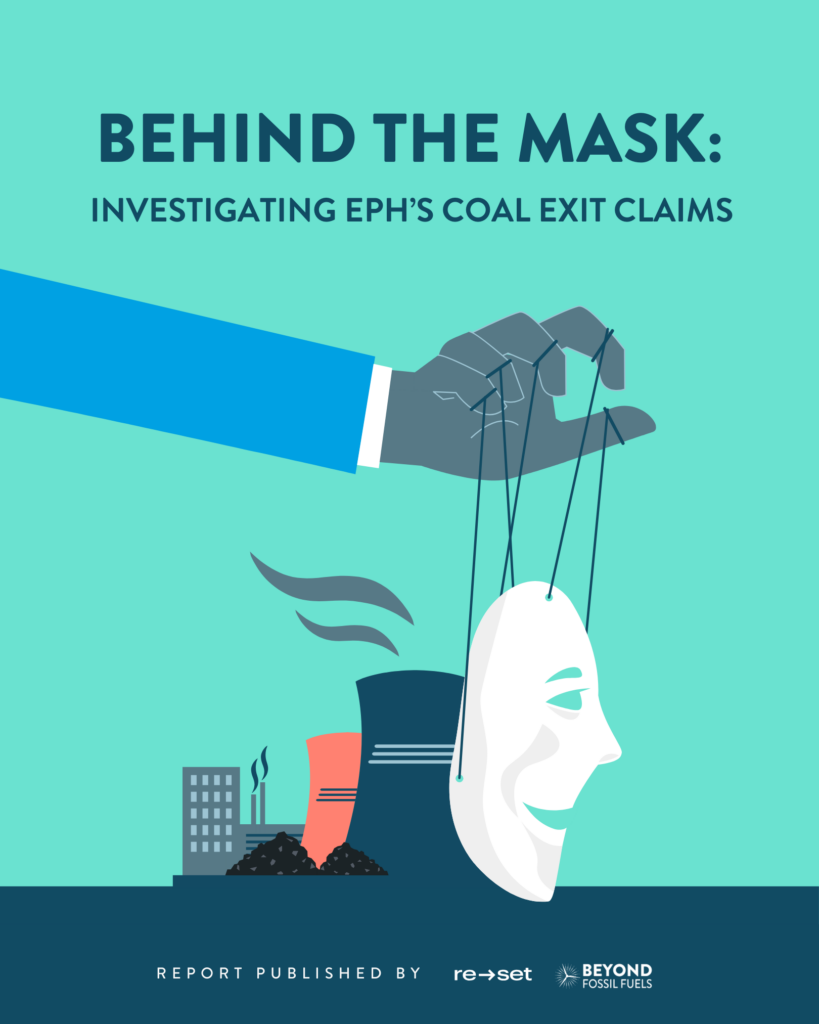
Energy companies must set clear, time-bound targets for phasing out coal by 2030 and fossil gas from power generation by 2035, in line with what the science demands. Transition plans must be independently verified, publicly reported, and free from accounting tricks that allow companies to claim progress while extending fossil fuel operations. Shuffling coal assets to subsidiaries or spin-offs is not a transition; it is a rebranding exercise. (link to EPH report)
2. Stop lobbying against the clean transition.
We will not accept a situation where energy companies publicly endorse climate targets while quietly lobbying governments to weaken the very policies designed to achieve them, from the EU ETS to capacity market rules, methane regulations and renewable energy permitting. Corporate climate commitments must be matched by corporate political behaviour.
3. Stop seeking gas subsidies through the back door Capacity markets were designed to ensure energy security.
They were not designed to hand billions in public money to fossil fuel companies to build infrastructure Europe does not need. We call on energy companies to stop pushing for capacity market designs that favour fossil gas over clean, flexible alternatives, and to disclose publicly any capacity market revenues they receive.
4. Invest in clean flexibility, not new fossil gas.
The energy system needs flexibility, but that flexibility does not have to come from gas – it can and should be clean. Utilities should redirect investment from new gas power plants to batteries, demand response, pumped hydro and smart grid solutions that provide the same system balancing services at lower cost and without locking in decades of fossil fuel dependence.
5. Procure genuinely additional renewable energy.
Companies operating energy-intensive assets, including data centres, must purchase new, additional and locally-sourced renewable energy to replace their fossil fuel consumption, rather than relying on accounting mechanisms that claim renewable status while the underlying electricity supply remains partly fossil: “100% renewable” must mean what it says.
6. Support workers and communities, not just shareholders.
Energy companies must work with trade unions, local communities and governments to develop and fund socially responsible closure plans for coal and gas plants, ensuring that workers are retrained, communities are reinvested in, and no one is left behind.
-
Related resources

The power sector will play a make-or-break role in enabling a fast and fair energy transition. Readily-available and easily-deployable sustainable power solutions (wind, solar, storage and grids) will not only decarbonise electricity production; they will pave the way for other sectors to follow suit.
At the same time, fossil-owning utilities obstruct progress, often by engineering regulatory gaps and loopholes that weaken our climate safeguards. They’re pushing Europe to overbuild polluting power plants, which keep us locked into volatile fossil fuels for longer.
Europe’s energy companies stand at a crossroads. Those that align their business with the clean energy transition stand to gain. Those that resist it, lobbying for subsidies, locking in new fossil gas, or dressing up delay as ambition, are choosing a path that is costly for consumers, damaging to the climate, and ultimately a dead end.
“Trying to halt runaway climate chaos while still investing in fossil fuels is akin to training for a marathon while smoking a packet a day. Although many utilities are investing in sustainable power solutions, it is critical that they roll out ambitious step-by-step plans to move away from fossil gas by 2035 if they want to fulfil their potential to become key drivers of Europe’s energy transition.”
Big Tech
Big Tech
-
What’s the role of Big Tech in the energy transition?
The digital economy runs on electricity. As artificial intelligence drives an unprecedented surge in data centre demand across Europe, governments face a choice: pursue AI at the expense of other sectors, or put affordability and energy security for European consumers and businesses first and set necessary limits on this sector. Tech companies, meanwhile, must put a stop to greenwashing and set their business plans to sustainable levels, or drag Europe back to fossil fuels in pursuit of profit.
People see untethered data centre growth as a threat to Europe’s energy and water security, and want Big Tech to be regulated. In a poll commissioned from Savanta (Sep 2025) (link), a majority of Europeans said they want rules to limit the impact of new data centres on energy, water and energy bills. The results show strong support for powering new data centres with additional renewables (72% of respondents), alongside broad opposition to fuelling them with fossil energy.
“At a time when Europe’s power system operators are working to meet the demands of the energy transition and Europe’s climate objectives, additional electricity needs from new data centre growth could be a real challenge. If data centre growth relies on fossil gas, it will fuel the climate crisis. The tech sector’s huge energy grab could also mean fewer renewables available for other sectors. To prevent this, measures must be in place to ensure that new data centres go hand in hand with the buildout of additional renewable energy. If tech companies cannot bring their demand growth in line with climate science, then it must be limited.”
-
What we’re asking of Big Tech and data centre operators
1. Be honest about your energy footprint.
The first step is transparency. Data centre operators must publicly disclose their electricity consumption, water use, electricity supply mix, and carbon emissions, including for chip manufacturing, for each owned or leased facility in real time. Claims of being “100% renewable” must be substantiated with evidence of genuine clean energy procurement, not creative accounting. If your data centre is powered partly or fully by fossil gas, coal or nuclear, this must be disclosed.
2. Procure new, additional and local renewable energy.
Buying renewable energy certificates from existing wind and solar farms does not add a single watt of clean power to the grid. Tech companies must commit to procuring new, additional renewable energy capacity, built specifically to meet their extra energy demand and matched to the location and time of their actual consumption. Anything less perpetuates the illusion of sustainability while the reality remains fossil-powered.
3. Stop pushing fossil fuels onto the grid.
Data centres that connect to grids already under strain without investing in new, renewable energy generation are effectively increasing fossil fuel use, regardless of what their sustainability reports say. Tech companies must take responsibility for the system-wide impact of their energy demand, and invest in grid infrastructure, storage and clean flexibility to support, not undermine, the transition. Tech companies must not develop on-site gas plants that increase Europe’s reliance on imported fossil fuels, and drive up emissions and energy costs.
-
What we are asking policy makers to do about Big Tech and data centres
1. Do not crowd out critical societal needs and public services.
Data centres must not receive priority access to electricity grids over other critical sectors, such as business and industry, and public services such as hospitals, schools, housing, and food systems. Grid rules must ensure access to affordable power for electrifying industries as well as buildings and transport. The energy needs of communities come first.
2. Protect ordinary people’s bills from data centre costs.
Data centre expansion is not costless: it is being paid for by households through their electricity bills. Research commissioned by Beyond Fossil Fuels and Friends of the Earth Ireland found that Irish households paid an estimated €715 million in additional electricity costs between 2015 and 2023, as data centre demand forced expensive fossil gas to set the wholesale price more often. Unabated, this could cost households up to € 1.43 billion in the coming decade. Ireland is an extreme case, but the mechanism is the same across Europe: inflexible, round-the-clock data centre demand cannibalises renewable energy, keeps fossil gas in the system, and drives up costs for everyone else. Tech companies must be directly financially responsible for the grid costs that their growth creates, and ordinary people should not subsidise their expansion.
3. Align data centre policies with energy security and climate objectives.
Today Europe’s data centre expansion policies put at risk critical policies and targets, such as electrification and energy transition targets, and energy affordability measures. Designed to ensure Europe has resilient, affordable and renewable energy. Europe must place sustainable limits on data centre expansion and ensure it does not lead to an increased reliance on fossil gas or reduce the supply of renewable energy available to critical sectors and industries.
4. Give local communities a democratic say in decisions that affect them.
Data centres do not appear in a vacuum. They affect local land use, water supplies, grid capacity and community character. Data centre development must ensure meaningful community consultation before building. Permitting processes must be respected, including conducting full environmental impact assessments. As part of this process, data centre developers must be required to disclose verifiable data on planned energy consumption and sources, water usage, efforts to reduce impacts on local communities, and ownership of the facility.
-
Related resources
Links will be here, format TBC
The digital economy runs on electricity. As artificial intelligence drives an unprecedented surge in data centre demand across Europe, governments face a choice: pursue AI at the expense of other sectors, or put affordability and energy security for European consumers and businesses first and set necessary limits on this sector. Tech companies, meanwhile, must put a stop to greenwashing and set their business plans to sustainable levels, or drag Europe back to fossil fuels in pursuit of profit.
People see untethered data centre growth as a threat to Europe’s energy and water security, and want Big Tech to be regulated. In a poll commissioned from Savanta (Sep 2025) (link), a majority of Europeans said they want rules to limit the impact of new data centres on energy, water and energy bills. The results show strong support for powering new data centres with additional renewables (72% of respondents), alongside broad opposition to fuelling them with fossil energy.
“At a time when Europe’s power system operators are working to meet the demands of the energy transition and Europe’s climate objectives, additional electricity needs from new data centre growth could be a real challenge. If data centre growth relies on fossil gas, it will fuel the climate crisis. The tech sector’s huge energy grab could also mean fewer renewables available for other sectors. To prevent this, measures must be in place to ensure that new data centres go hand in hand with the buildout of additional renewable energy. If tech companies cannot bring their demand growth in line with climate science, then it must be limited.”
Steel + Industry
Steel + Industry
-
What’s the role of the steel industry in the energy transition?
Steel is the backbone of Europe’s economy, but it is also one of its biggest carbon emitters, responsible for 5% of the EU’s total greenhouse gas emissions. With 47 coal-based blast furnaces still operating across the continent, the industry stands at a crossroads. The good news: a clear pathway to renewables-based steel exists, and Europe can still be a front-runner in near-zero emission steel innovation. The question is whether steelmakers will seize it, or use the current energy crisis as an excuse to delay.
“The EU was built on coal and steel; now it must forge its future from fossil-free industries. Decisions made today will largely determine whether Europe leads or loses out in the green industrial transition. Ambitious investments in renewable energy and grid infrastructure are essential to decarbonise steel production and secure a thriving green steel industry for generations to come. Policymakers must ensure this transition is fair for workers and communities, and delivers benefits for society as a whole.”
-
What we’re asking of the steel industry
1. Stop investing in coal-based infrastructure.
The EU still operates 47 coal-fired blast furnaces generating 133 million tonnes of CO₂ every year. While new coal-based blast furnaces are not being considered in Europe, yet not a single one among the existing fleet should be upgraded and relined. Every euro invested in coal-based steelmaking today is a euro wasted, and a liability for the future. Steelmakers must commit publicly to no further investment in coal-based assets and set clear, binding retirement dates for every existing furnace.
2. Publish credible, transparent transformation plans Vague net-zero pledges are not enough.
Steel companies must produce timely, ambitious and transparent transition plans at company and site level with concrete decarbonisation milestones, investment commitments and just transition measures for workers and communities. Plans that lack concrete milestones, investment commitments or just transition provisions should not qualify for public support.
3. Accelerate the shift to green steel technologies.
The technologies exist. Hydrogen-based direct reduced iron and electric arc furnaces powered by renewable energy must be scaled up. Companies that are not yet on this path must get on it, and those that are must move faster. Investing in green steel today is what secures jobs, competitiveness and industrial leadership tomorrow.
4. Commit to buying and selling low-emission steel.
Decarbonising production only works if there is a market for the result. Steel companies must work with their customers, in construction, automotive and manufacturing, to build demand for renewables-based steel and develop long-term supply agreements that make green steel commercially viable at scale.
5. Make public support conditional on delivery.
European taxpayers and the EU budget are supporting the steel industry’s transition. That support must come with conditions. Companies that are not genuinely committed to decarbonisation, that lobby against climate policy, delay furnace closures, or use public funds without delivering emissions reductions, should not receive it. Public money must drive real change, not reward inaction.
6. Support workers and communities, not just balance sheets.
Steel employs hundreds of thousands of people across Europe, many of them in regions with few alternatives. The transition must be fair. Companies must engage workers and unions early, invest in reskilling and retraining, and ensure that no community is left behind as blast furnaces close. A just transition is not optional – it is a condition of legitimacy.
-
Related resources
Links will be here, format TBC
Steel is the backbone of Europe’s economy, but it is also one of its biggest carbon emitters, responsible for 5% of the EU’s total greenhouse gas emissions. With 47 coal-based blast furnaces still operating across the continent, the industry stands at a crossroads. The good news: a clear pathway to renewables-based steel exists, and Europe can still be a front-runner in near-zero emission steel innovation. The question is whether steelmakers will seize it, or use the current energy crisis as an excuse to delay.
“The EU was built on coal and steel; now it must forge its future from fossil-free industries. Decisions made today will largely determine whether Europe leads or loses out in the green industrial transition. Ambitious investments in renewable energy and grid infrastructure are essential to decarbonise steel production and secure a thriving green steel industry for generations to come. Policymakers must ensure this transition is fair for workers and communities, and delivers benefits for society as a whole.”
Financiers
Financiers
-
What’s the role of financiers in the energy transition?
Financial institutions have the power to make or break the shift away from fossil fuels: the financing decisions being made today will determine how successfully Europe decarbonises its power sector by 2035. Right now, banks are falling short.
A review of the world’s 60 largest private banks found that 52 have no financial targets for sustainable power whatsoever, and only two explicitly include energy storage. Meanwhile, major banks continue to finance fossil fuel companies whose strategies risk locking Europe into billions of euros of costly gas imports for years to come.
“The financing decisions being made today will determine how successful Europe will be at decarbonising its power sector tomorrow. Financial actors can and must engage with their power utility clients to make a genuine contribution to the transition to a fossil-free, renewables-based power sector.”
-
What we’re asking of financiers
1. Stop financing new fossil fuel infrastructure.
Every euro channelled into new gas power plants, LNG terminals or coal assets today is a euro working against Europe’s energy future. Banks must adopt and enforce credible fossil fuel phase-out policies, with clear timelines, asset-by-asset commitments, and no loopholes for so-called “flexibility” projects that are fossil gas in disguise. The TotalEnergies-EPH joint venture is a textbook example of what banks should not be enabling.
2. Set comprehensive, ambitious clean energy financing targets.
Financing wind and solar is not enough. Europe’s energy transition depends equally on batteries, storage, grids and clean flexibility infrastructure, yet most banks’ sustainable finance targets cover only power generation, leaving the rest of the system unfinanced. Banks must set explicit, ambitious financing targets that cover the full suite of clean energy infrastructure, in line with the G20 and COP29 commitment to a sixfold increase in storage capacity by 2030.
3. Use your leverage and engage utility clients on transition plans.
Banks and investors are among the most powerful actors in the room when it comes to holding utilities accountable. BFF research found that European power utilities like RWE and EPH continue to develop new fossil gas plants. Financial institutions must use their relationships, their shareholder voice and their lending conditions to push utility clients to publish credible, science-aligned transition plans, and to withhold support from those that don’t.
4. Align financing ratios with climate science.
Even in Europe, major banks currently allocate three-quarters of their clean energy finance to electricity generation, leaving just a quarter for grids and storage. That ratio must change. Banks should target a 6:1 financing ratio in favour of sustainable power supply over fossil fuels by 2030, and ensure that storage and grid infrastructure receive a share of clean energy investment.
5. Disclose, and clean up your lobbying.
Financial institutions that publicly back net-zero targets while quietly opposing the regulatory frameworks needed to achieve them are not credible transition partners. Banks must disclose all lobbying activity related to energy and climate policy, end engagement that conflicts with decarbonisation goals, and ensure that their industry association memberships do not undermine the commitments they make in public.
Financial institutions have the power to make or break the shift away from fossil fuels: the financing decisions being made today will determine how successfully Europe decarbonises its power sector by 2035. Right now, banks are falling short.
A review of the world’s 60 largest private banks found that 52 have no financial targets for sustainable power whatsoever, and only two explicitly include energy storage. Meanwhile, major banks continue to finance fossil fuel companies whose strategies risk locking Europe into billions of euros of costly gas imports for years to come.
“The financing decisions being made today will determine how successful Europe will be at decarbonising its power sector tomorrow. Financial actors can and must engage with their power utility clients to make a genuine contribution to the transition to a fossil-free, renewables-based power sector.”